

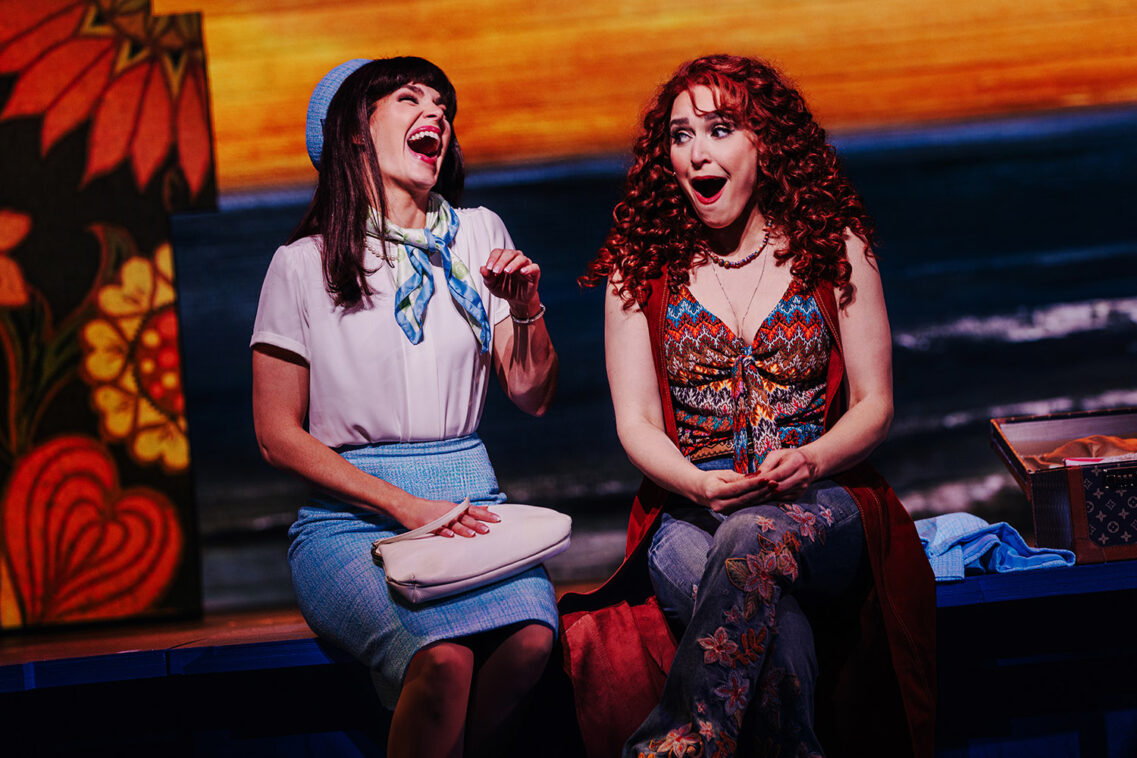


“Beaches” – the story of a lifelong friendship
Its title notwithstanding, “Beaches” only spends a few moments by the seashore. It starts and ends on a beach, but the rest of the time the action takes place for the most part in clubs and on stages, and it involves two women who first meet when they are little girls and whose friendship lasts until one of them disappears.
Based on the 1985 novel by Iris Rainer Dart (also the author of the book with Thom Thomas), and the film released in 1988, this old-fashioned, low-key, tear-jerking musical is enhanced by some melodic tunes (“Wish I Could Be Like You”, “Show the World Who You Are”, “The Words I Should Have Said”, “A Day at the Beach”) provided for this occasion by Mike Stoller, best known for the songs he wrote in the 1950s with Jerry Leiber, like “Hound Dog”, “Love Me” and “Jailhouse Rock”, which became huge hits for Elvis Presley.
Essentially the story deals with those two young pearls, Cee Cee Bloom, an over-the-top exuberant imp, and Bertie White, a shy, introverted one, who meet on a beach one day and develop a friendship that will last in spite of all the difficulties they encounter. As it turns out, Cee Cee succeeds at being a street-smart singer, first in nightclubs until she moves to higher levels and becomes a well-known and admired actress; meanwhile Bertie, controlled by her mother Rose, lives a somewhat hidden existence and becomes a lawyer. All along, they keep in touch. Eventually, they both get married, Cee Cee to John, who will leave her after a while to live his life alone, and Bertie with Michael, who has an affair with Cee Cee when Bertie is pregnant, which leads to their divorce and a breakdown between the two friends. Ultimately, after a while, they reconcile and retain their friendship until Bertie dies at the end of the show.
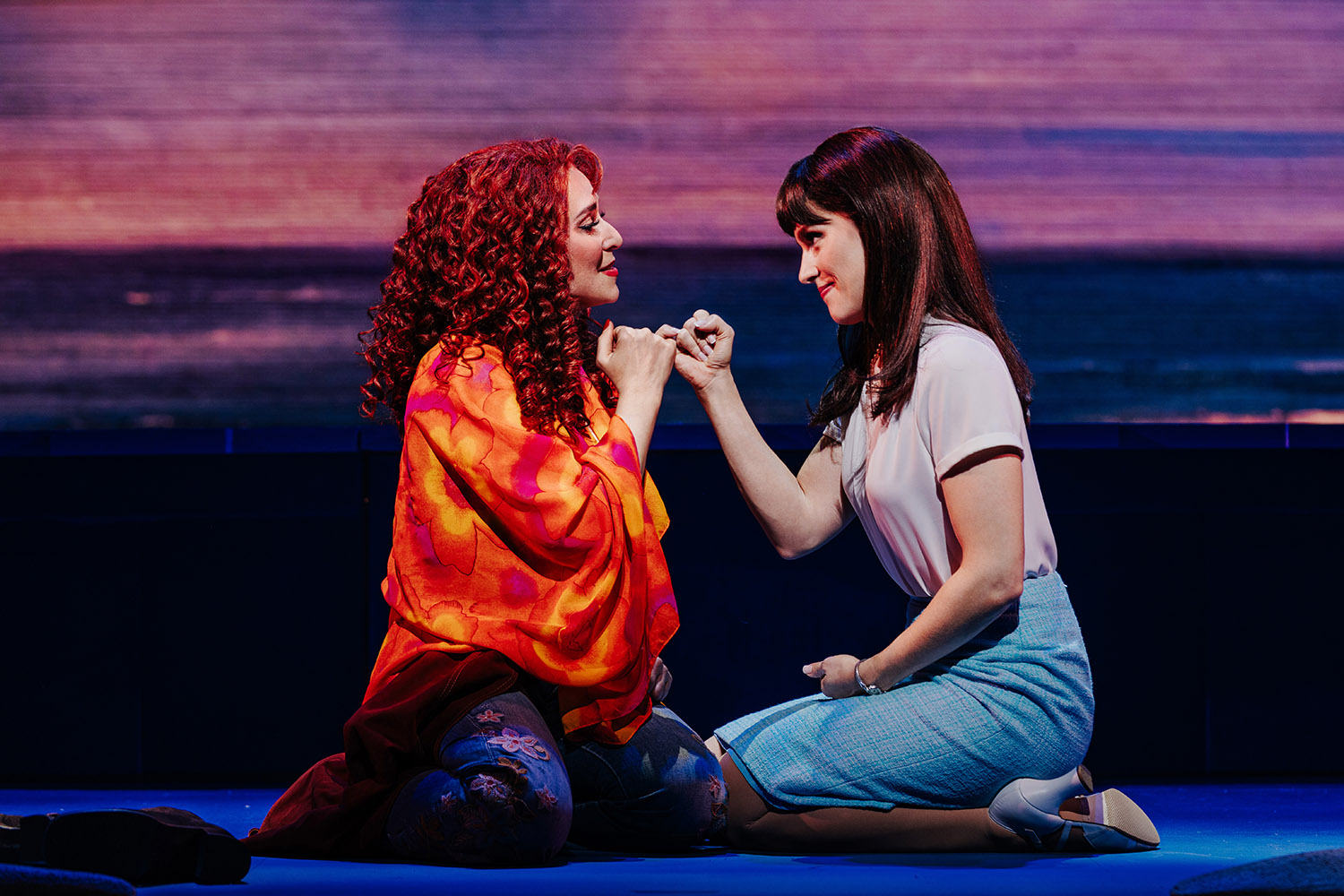


While the story is stretched over two acts, and much of the action provokes hysterical moments, particularly thanks to Cee Cee’s explosive nature, the death of Bertie adds a sad counterpoint to everything that preceded it, a conclusion that leaves the audience emotionally responsive.
Given the relatively small impact of the narrative, one has to rely on the other assets the show presents, and particularly the performances. Way ahead of the cast, the two artists deliver the goods, Jessica Vosk exhilaratingly percussive as Cee Cee, her first leading role and a splendid effort on her part; and Kelli Barrett, seductive as Bertie, in a low-key role that requires that she confront Jessica Vosk’s permanent overboard presence. Next to them, there is also the little Samantha Schwartz as young Cee Cee, whose brilliant and self-assured performance in several scenes makes her another jewel of this production. Others who also make a good impression include Ben Jacoby as Michael, Brent Thiessen as John, and Zurin Villanueva as Sandy and Janice.
The settings designed by James Noone, as well as the costumes by Tracy Christensen and the lighting by Ken Billington put their own touches to the ensemble and provide visual details that enhance the spectacle. Choreographed by Jennifer Rias and directed by Lonny Price and Matt Cowart, the show is not as physically exciting as other productions currently on Broadway, but it has a realistic flair that is not negligible and a story that is solidly narrated.
Music Supervision: Joseph Thalken • Music Direction: Paul Staroba • Direction: Lonny Price • Co-Direction: Matt Cowart • Choreography: Jennifer Rias • Scenic Design: James Noone • Costume Design: Tracy Christensen • Wig, Hair & Makeup Design: J. Jared Janas • Projection Design: David Bengali • Lighting Design: Ken Billington • Sound Design: Kai Harada • With: Jessica Vosk (Cee Cee Bloom), Kelli Barrett (Bertie White), Sarah Bockel (Leona and others), Harper Burns (Nina and others), Zeya Grace (Little Bertie), Ben Jacoby (Michael and others), Lael Van Keuren (Rose and others), Emma Ogea (Teen Bertie and others), Bailey Ryon (Teen Cee Cee and others), Samantha Schwartz (Little Cee Cee), Brent Thiessen (John and others), Zurin Villanueva (Janice and others)
Cover photo: Marc J. Franklin